This week’s suggestions are especially for those who are just starting out in the arts or trying to ‘navigate’ the complexities of the art world.
The truth is that, despite all the love we may have for art, we cannot sugar-coat the reality and claim that the life of an artist or creative professional is a bed of roses, because, generally speaking, it isn’t. And, unfortunately, simply having ‘talent’ is just not enough.
In these three books we’re recommending today, we offer a slightly more positive perspective for anyone wishing to venture into this world.
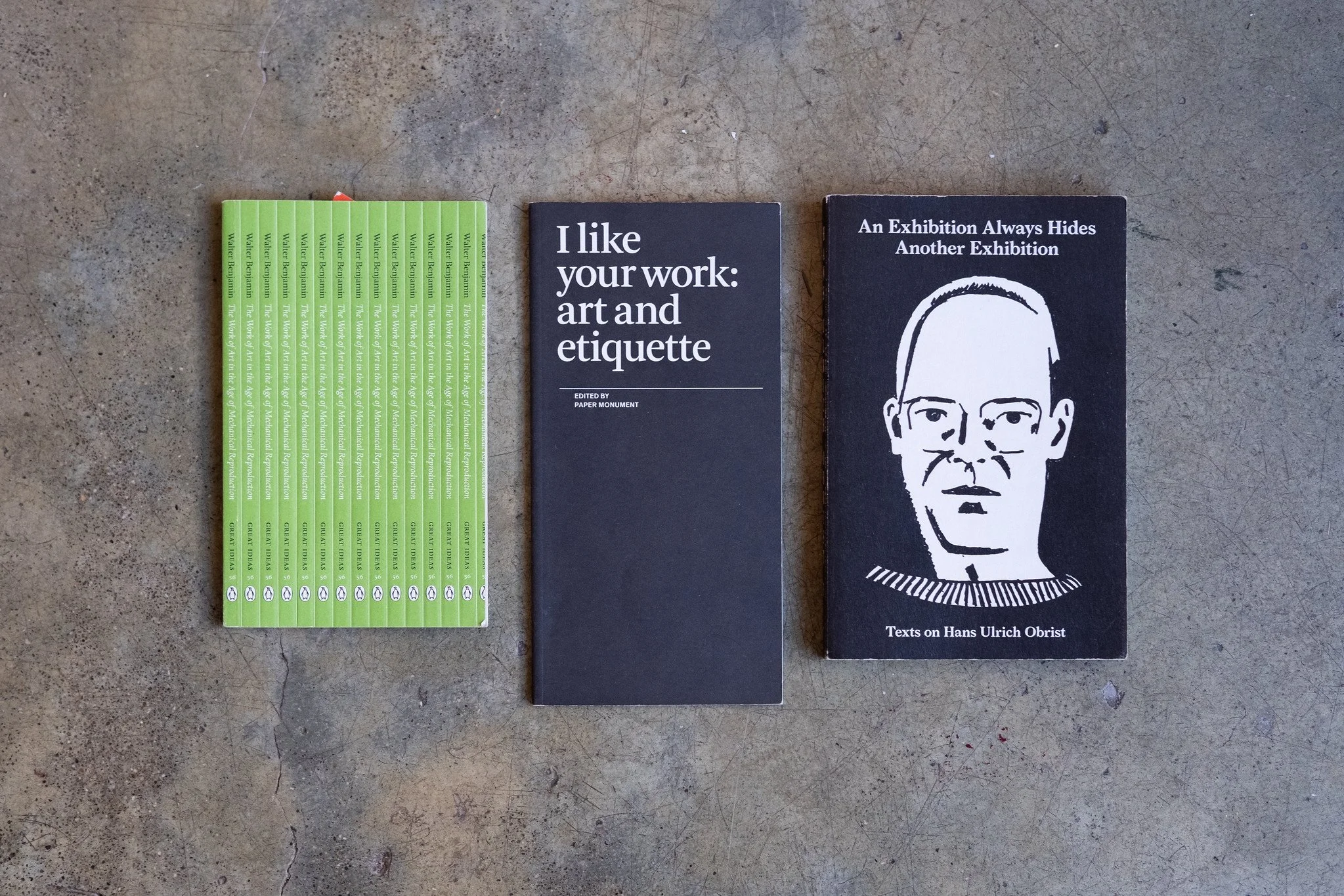
Walter Benjamin - The Work of Art in the Age of Mechanical Reproduction, pub 1935 (Penguin)
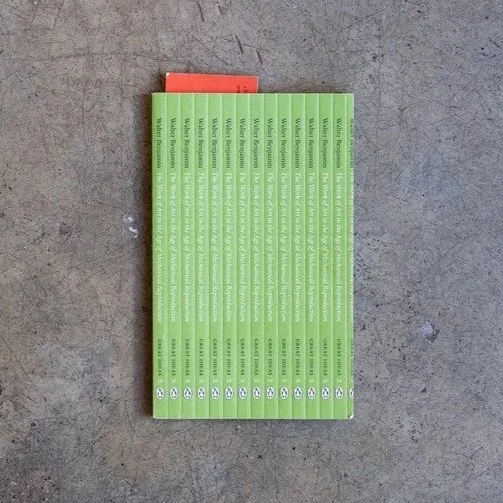
In his essay ‘The Work of Art in the Age of Mechanical Reproduction’ (published in 1934), Walter Benjamin addresses artists and discusses their struggles in an age in which creative work can be reproduced and mass-produced through photography, photoprinting and other techniques. He also discusses the ‘aura’ of the original work and how it is diminished through reproduction. Ninety years on, we are having the same conversation, which is somewhat comforting.
“One might subsume the eliminated element in the term “aura” and go on to say: that which withers in the age of mechanical reproduction is the aura of the work of art. This is a symptomatic process whose significance points beyond the realm of art. One might generalize by saying: the technique of reproduction detaches the reproduced object from the domain of tradition. By making many reproductions it substitutes a plurality of copies for a unique existence. And in permitting the reproduction to meet the beholder or listener in his own particular situation, it reactivates the object reproduced. These two processes lead to a tremendous shattering of tradition which is the obverse of the contemporary crisis and renewal of mankind.”
I like your work: art and etiquette, 2009 (Paper Monument)
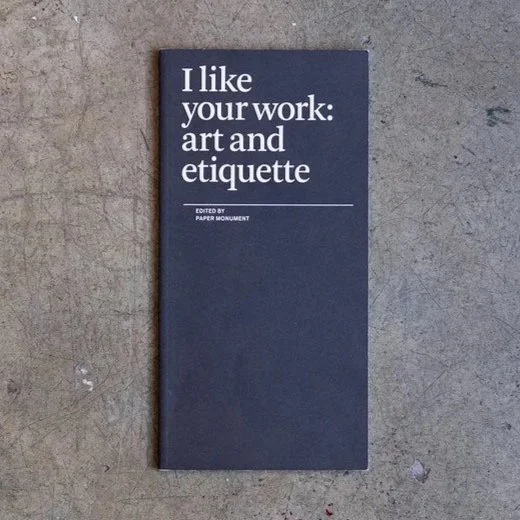
This little book is both a caricature of the art ‘market’ and a guide to navigating it. The idea is simple: to put the same questions to different players, such as artists, curators, critics and gallery owners. ‘What are the rules of etiquette in the art world?’, ‘What customs and “quirks” exist in the art world?’, ‘What constitutes “bad manners”?’. In addition to the questionnaires, the book also includes a selection of essays, such as Angie Keefer’s ‘Polite Terrorism’ and Naomi Frey’s ‘What it takes to sell yourself’.
“The art world is now both socially professional and professionally social. Curators visit artists’ studios; collectors, dealers, and journalists assemble for a reception and reconvene later for dinner; everyone goes to parties. We exchange introductions and small talk; art is bought and sold; careers (and friendships) brighten or fade. In each situation, certain behaviors are expected while others are silently discouraged. Sometimes, what’s appropriate in the real world would be catastrophic in the art world, and vice versa.
Making these distinctions on the spot can be nerve-wracking and disastrous. So we asked ourselves: What is the place of etiquette in art? How do social mores establish our communities, mediate our critical discussions, and frame our experience of art? If we were to transcribe these unspoken laws, what would they look like? What happens when the rules are broken? Since we didn’t have all the answers, we politely asked our friends for some help.”
An Exhibition Always Hides Another Exhibition - Texts on Hans Ulrich Obrist (2019), Sternberg Press
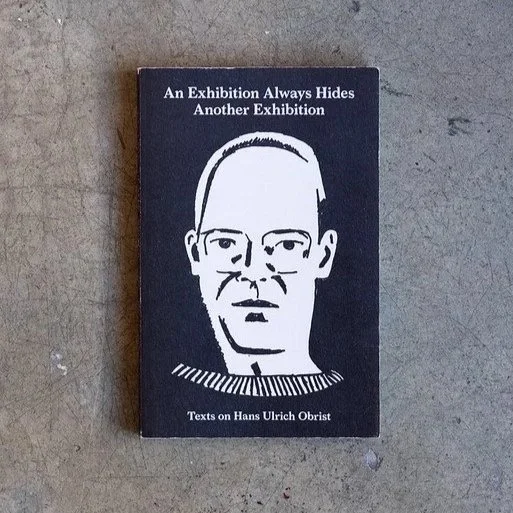
In this book, the roles are reversed, and a group of some of the most influential artists of recent decades talk about the indispensable Hans Ulrich Obrist – a man who, as well as being one of the most influential curators of all time, has spent the last few decades interviewing creative minds. By focusing on the curator, the book helps us to understand the fundamental role of those whose profession is to interpret the work of others.
“Hans Ulrich Obrist is the Kim Kardashian of the art world. That sounds absurd to those of you who know him. But there are many who know just his name or just his initials, HUO. This book is here to tell you more. What does it mean to be HUO? What does it mean to be a curator? Is there anything less interesting to me (or you?) than selecting artists for exhibitions? In an era of, let's call it, “boutique” art shows, the issue seems about as relevant as Diet Coke (and the Kardashians). But if anything, Hans is the Real Thing. Hans is Coca-Cola. In this book you'll find personal, anecdotal remarks on HUO's character, republished texts, and portraits (by artists including Alex Katz) that give context to the questions that frame the book: “Who is HUO?” and “What does HUO do?” More so, “What has he done?” If the art world were to seek out a supreme leader who was benevolent, kind, and fair, HUO would be it.”